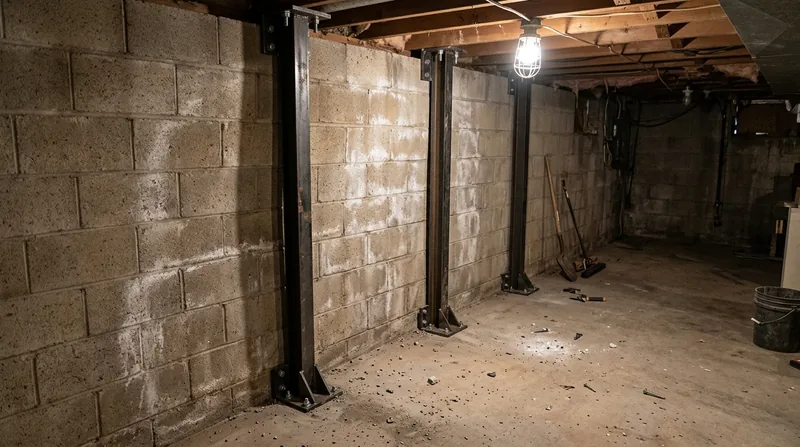




St. George sits where red sandstone cliffs and black lava ridges meet the Virgin and Santa Clara rivers, and that geology writes the rules for foundations here. Expansive clay and gypsum-rich soils swell when landscape or golf-course irrigation soaks them, then collapse when they dry, and the pressure lands on below-grade walls. On the Black Hill slopes and in the walk-out lower levels stepping down Stone Cliff, The Ledges, Green Valley and Entrada, the uphill block wall takes the worst of it. If you are searching for Bowing Wall Repair in St. George, you are usually looking at a wall that has moved inward an inch or more, with a horizontal crack at mid-height and doors that no longer square up. We stabilize that movement with carbon fiber straps, steel I-beams or wall anchors, matched to the severity of the bow and the soil pushing on it. Start with a free basement inspection so we can measure the actual movement instead of guessing from the inside face.
Why Bowing Walls Show Up in St. George Hillside Homes
Most bowing we see in Washington County is not a concrete problem, it is a soil and water problem. The clay and gypsum layers under St. George take on water from irrigation, monsoon cloudbursts and perched groundwater, expand against the wall, and stay expanded long enough to rack it inward. Pioneer-era homes downtown on red sandstone and black volcanic rock footings show it differently than a 1990s stucco walk-out, but the mechanism is the same: hydrostatic pressure with nowhere to go.
- Horizontal cracking at mid-wall height is the classic sign that backfill soil is pushing inward.
- Doors and windows that stick on the lower level often mean the wall has rotated, not that the frame swelled.
- White efflorescence along the crack line tells you water is moving through the block.
- Stair-step cracking in the mortar joints signals differential settlement on one corner of the footing.
- A wall that bulges more after a monsoon week is responding to saturation, and it will keep moving.
If the wall has moved less than about an inch and the crack is tight, crack sealing and moisture control may be all you need, and we will tell you that plainly instead of selling a full stabilization job.
Key info: A homeowner in Green Valley called us after a wall on the uphill side of the lower level moved nearly two inches over two summers. The cause was a sprinkler zone running against the foundation plus clay backfill. We anchored the wall and redirected the irrigation, and the movement stopped.
Structural repair of this kind touches permitting, and the City of St. George Building Department is the authority to confirm what your address requires: sgcity.org.
How We Stabilize a Bowing Wall in St. George
We do not pick a method before we know how far the wall has moved and what soil is behind it. The sequence below is what a typical stabilization looks like on a St. George walk-out or a mid-century ranch near Dixie with a lower level cut into the slope. The goal is to stop the movement and take the load off the wall, not to cosmetic-patch the crack and hope.
- We measure the bow with a string line and a level, and we map crack widths at three points along the wall.
- We inspect the exterior grade, downspout extensions and irrigation heads to find what is feeding the soil.
- We match the method to the movement: carbon fiber straps for a wall that is bowing but not displaced, steel I-beams for heavier load, wall anchors when the wall must be pulled back toward plumb.
- We install the system, torque it to spec, and seal the crack line so water cannot track through the repair.
- We correct the water source with grading and drainage, because a stabilized wall still fails if the clay keeps swelling.
Where the real driver is water pressure, an interior drain tile system often belongs in the same scope, since relieving the pressure is cheaper than fighting it forever.
Key info: On a 1970s split-level on the Black Hill, the uphill block wall had bowed about an inch and a quarter. Carbon fiber straps on 4-foot centers plus a regraded swale above the wall held it steady through the next monsoon season.
Matching the Repair Method to the Movement
Each approach solves a different stage of the problem, and using the wrong one wastes money. This is the short version of how we decide on a St. George property.
| Approach | Description | Best for |
|---|---|---|
| Carbon fiber straps | Epoxy-bonded straps span the crack and resist further inward movement. | Bowing under about 2 inches with no lateral displacement. |
| Steel I-beams | Vertical beams set against the wall and tied into the footing. | Heavier bow or a wall carrying hillside load. |
| Wall anchors | Exterior anchor plates pull the wall back toward plumb over time. | Walls that have moved outward and can be corrected. |
| Epoxy or polyurethane injection | Injection ports seal the crack itself and stop seepage. | Tight, non-moving cracks that only leak water. |
Injection alone does not fix a wall that is still moving, so we pair it with stabilization when the bow is active.
Bowing Wall Repair Cost in St. George: What to Expect
Pricing starts at $600, and that figure covers the smaller end of the work: crack sealing and injection on a wall that has not moved. Any stabilization adds material and labor, so the number climbs with wall length, the method chosen, and how much excavation the anchors require. Get two or three estimates and compare the method, not just the total.
- Wall length and the number of straps, beams or anchors drive most of the cost.
- Access matters: a walk-out wall on a Stone Cliff hillside takes more setup than a downtown basement.
- Soil conditions change the anchor depth, and gypsum-rich ground can require deeper embedment.
- Correcting the water source (grading, downspout extensions, irrigation) is a separate line item and worth doing.
- Emergency stabilization after a monsoon event costs more than scheduled work.
Our full pricing overview breaks down the ranges, and we confirm the scope in writing before any work starts.
Choosing a Bowing Wall Repair Contractor Near St. George
The right contractor measures the wall, explains why it moved, and tells you when a simpler repair is enough. Ask for a Utah license number and a certificate of insurance before anyone touches the foundation, and call the references on similar hillside or older downtown homes.
- Confirm the license and insurance in writing, not just verbally.
- Get two or three written estimates with the method named, not a single lump sum.
- Ask whether the company has stabilized walls on your soil type and slope.
- Check whether structural repair at your address needs a permit from the City of St. George before work begins.
- Ask how they will address the water source, since a stabilized wall still fails if the clay keeps swelling.
We are a Basement Health Association member and we specialize below grade, which is a different trade from general foundation work. Reach out through our contact page or call (435) 319-8116 to schedule a look at the wall.
Bowing Wall Repair in St. George: Pricing Guide
| Service | Price | Details |
|---|---|---|
| Crack injection and sealing | Starting at $600 | Seals a tight, non-moving crack; price rises with crack length and number of ports. |
| Carbon fiber strap stabilization | Starting at $1,800 | Straps on 4-foot centers; total moves with wall length and strap count. |
| Steel I-beam installation | On estimate | Heavier hillside load needs an on-site look at footing depth and beam spacing. |
| Wall anchor system | On estimate | Exterior excavation and anchor depth vary with soil and access on the slope. |
| Travel | Included | in St. George and surrounding Washington County areas, no separate call-out or mileage fee. |
| Estimate | Free | Response within 24h at (435) 319-8116, no obligation to book. |
Indicative pricing, the exact cost depends on square footage, finish, and site access. Free personalized estimate within 24h at (435) 319-8116.


