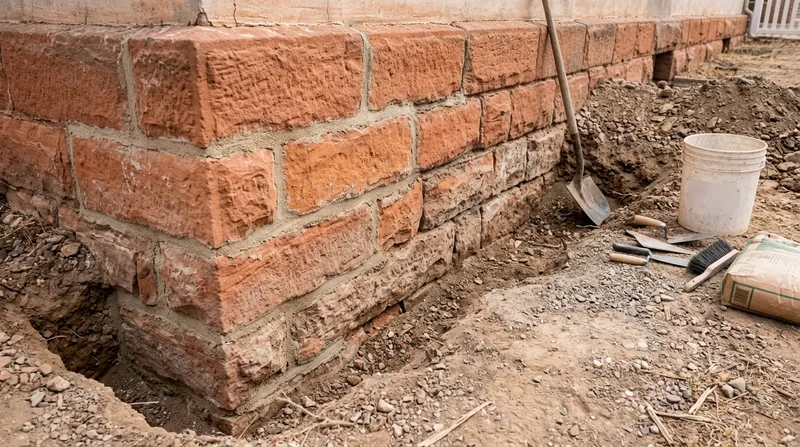




St. George sits in the Mojave Desert where red sandstone cliffs and black lava ridges meet the Virgin and Santa Clara rivers, and the ground under your home is anything but stable. Expansive clay and gypsum-rich soils swell when wetted and collapse when they dry, perched groundwater from landscape and golf-course irrigation moves sideways through the soil, and monsoon cloudbursts send water against foundations that spend most of the year bone dry. Foundation Waterproofing in St. George means reading that ground correctly before we touch a wall. We work on 1860s pioneer homes downtown with red sandstone and black volcanic rock footings, 1950s to 1980s ranches and split-levels near Dixie and on the Black Hill slopes, and 1990s to 2020s stucco homes with walk-out lower levels stepping down the hillsides of Stone Cliff, the Ledges, Green Valley and Entrada. If you are seeing efflorescence, wall seepage or water after rain, start with a free basement inspection so we can tell you whether you have a simple crack or a hydrostatic pressure problem.
Why Foundation Waterproofing Matters on St. George Soil and Stone
The failure mode that dominates here is not constant wet ground. It is the swing between scorching dry summers and sudden monsoon cloudbursts, which cycles expansive clay against a foundation wall until hairline cracks open and water finds them. Add perched groundwater from irrigation on the Black Hill slopes and around the golf courses, and you get wet basement calls in July and August that had no warning in May.
- Expansive clay and gypsum-rich soils push and pull on footings as moisture changes, and gypsum can dissolve and leave voids under a wall.
- Pioneer-era sandstone and volcanic rock foundations downtown absorb water and need breathable, lime-based repointing rather than hard Portland mortar.
- Walk-out lower levels on the Stone Cliff and Entrada hillsides collect water at the uphill wall where the grade meets stucco.
- Washes and river bottoms flash-flood, as in 2005, and send surface water against foundations that were never designed for it.
- Perched groundwater from landscape and golf-course irrigation keeps soil saturated long after the sprinklers shut off.
We match the repair to the wall we actually find, because a 1900 sandstone footing and a 2015 poured wall fail in completely different ways.
Key info: On a downtown St. George pioneer home, repointing with compatible lime mortar lets the sandstone wall breathe and shed moisture. Sealing that same wall with a hard, non-breathable coating traps water inside the stone and accelerates spalling, which is why period-appropriate materials matter here.
Structural foundation repair and work that alters drainage or the sanitary connection of a sump discharge commonly require permits, and thresholds vary by jurisdiction. Always verify current rules with the City of St. George building department before work begins: City of St. George official site.
How We Waterproof a St. George Foundation, Step by Step
We start below grade and work outward from the actual source. That means a full perimeter walk, a moisture reading on the wall, a look at the drain tile and footing drain, and a check of grading and downspout extension before anyone quotes a repair. Only then do we choose between crack injection, membrane or crystalline treatment, and drainage correction.
- We inspect the foundation from the inside and the outside and map every crack, efflorescence stain and seepage point.
- We identify the wall type (sandstone, volcanic rock, block or poured concrete) and test how the existing mortar and coatings behave.
- We repair cracks with epoxy injection for structural cracks or polyurethane injection for active leaks, using injection ports set at the right spacing.
- We correct drainage with drain tile repair, a footing drain, or grading and downspout extension so water moves away from the wall.
- We apply the right treatment: breathable lime repointing on pioneer stone, or a waterproof membrane or dimple board on poured walls.
- We verify the repair with a water test and leave you with a written record of what was done and what to watch.
If the diagnosis points to pressure rather than a crack, we say so and steer you to an interior drain tile system instead of selling you a sealant that will fail.
Key info: A Santa Clara home on expansive clay showed a wet wall every August but stayed dry all winter. The crack was minor. The real problem was a downspout dumping roof water two feet from the foundation and a grade that sloped back toward the wall. We extended the discharge, re-graded the soil, injected the crack, and the wall has stayed dry through two monsoon seasons.
Foundation Waterproofing Methods We Use in Washington County
No single method fits every foundation in St. George. We pick based on wall material, water source, and whether the problem is a crack, a drainage failure, or hydrostatic pressure.
| Approach | Description | Best for |
|---|---|---|
| Epoxy or polyurethane injection | Injection ports deliver epoxy for structural cracks or polyurethane for active leaks, sealing from inside the wall. | Poured concrete and block walls with discrete cracks and no widespread pressure. |
| Lime repointing and parging | We cut out failed mortar and repack with compatible lime mortar so the stone can breathe and shed water. | Downtown pioneer homes with red sandstone and black volcanic rock foundations. |
| Waterproof membrane and dimple board | A below-grade membrane or dimple board protects the wall and creates a drainage gap against the footing. | Exterior access on poured walls where soil pressure and seepage are both present. |
| Crystalline treatment | Crystalline material penetrates the concrete and grows into cracks and capillaries to block water. | Damp, porous concrete walls where injection alone will not stop capillary seepage. |
| Drainage correction | We repair drain tile, correct grading, and extend downspouts so water never sits against the foundation. | Homes where the wall is sound but water is being delivered to it from the surface. |
When the source is hydrostatic pressure, no coating on the inside of the wall will hold it, and we tell you that plainly before you spend the money.
Foundation Waterproofing Cost in St. George: What to Expect
Most foundation waterproofing work in St. George starts from $3,500, and that figure covers crack injection, repointing, and drainage correction on a typical residential foundation. The number moves based on wall type, how much of the perimeter is affected, whether we need exterior excavation, and whether drain tile repair is part of the scope. A single injection on a poured wall is a small job. A sandstone pioneer foundation that needs full repointing and a new footing drain is not.
Access drives cost as much as the repair itself. A walk-out lower level on the Stone Cliff hillside may be easy to reach on the uphill side and impossible on the downhill side without excavation. A downtown home with mature desert willows, palms and mesquite tight against the foundation limits how we get equipment in. Those are real line items, not padding.
Get two or three estimates and compare scope, not just the bottom line. Ask each contractor what method they will use and why, whether permits are required, and what happens if they open the wall and find more damage. A low bid that skips the drainage correction will not fix a wet basement. See our full pricing overview for how the line items break down.
Hiring a Foundation Waterproofing Contractor Near St. George
Waterproofing is a below-grade specialty, not general foundation repair and not plumbing. Ask who actually does the work, confirm the company is licensed and insured, and request a certificate of insurance before anyone breaks ground. Check references from jobs in Washington County on similar wall types, because a contractor who only works on new poured concrete may not know how to handle a 1900 sandstone footing.
Understand the permit picture before work starts. Structural foundation repair, egress work and drainage alterations commonly need a permit, and the City of St. George building department sets the thresholds. Ask whether the contractor pulls the permit or expects you to. Confirm HOA requirements for any exterior work, and get the scope, method and warranty in writing. A transferable warranty is worth asking about, and a contractor who cannot explain the method in plain language is a risk.
We are a Basement Health Association (BHA) member and we specialize in below-grade work only. Reach out through our contact page to schedule an inspection, or call (435) 319-8116. We will tell you when simple crack sealing is enough and when the real problem is hydrostatic pressure.
Foundation Waterproofing in St. George: Pricing Guide
| Service | Price | Details |
|---|---|---|
| Crack injection (epoxy or polyurethane) | Starting at $3,500 | Covers injection ports, epoxy or polyurethane, and water testing on a typical residential wall. |
| Lime repointing on pioneer stone foundation | Starting at $4,200 | Includes cutting out failed mortar and repacking with compatible lime mortar; wall length drives price. |
| Membrane or crystalline wall treatment | Starting at $4,800 | Below-grade membrane or crystalline treatment with surface prep; exterior access and excavation move the number. |
| Drainage correction with drain tile repair | Starting at $5,500 | Includes drain tile repair, grading correction and downspout extension; footing depth and access are the main factors. |
| Complex or large-scale job | On estimate | Full-perimeter work on sandstone or hillside walk-out walls needs an on-site look before a number is given. |
| Estimate | Free | Response within 24h at (435) 319-8116, no obligation to book. |
Indicative pricing, the exact cost depends on square footage, finish, and site access. Free personalized estimate within 24h at (435) 319-8116.


