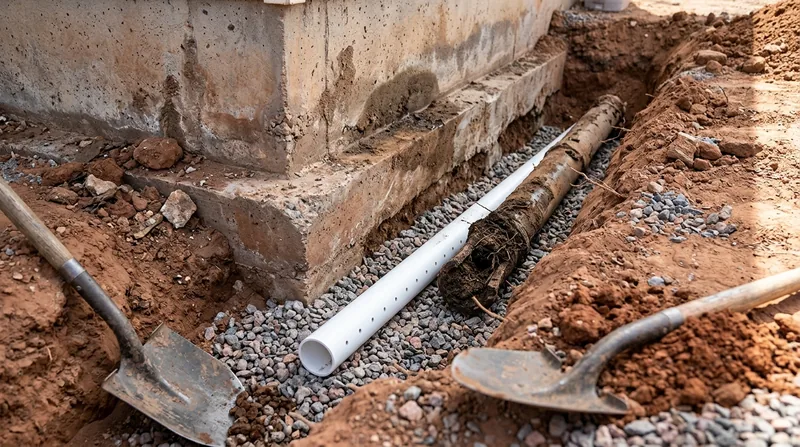




St. George sits where red sandstone cliffs and black lava ridges meet the Virgin and Santa Clara rivers, and that geology decides how water moves under your house. Expansive clay and gypsum-rich soils swell when wetted and collapse when they dry, and perched groundwater fed by landscape and golf-course irrigation keeps the ground under footings wet long after the monsoon cloudburst has passed. If your basement takes on water after a storm, or the sump runs nonstop in July, the problem is often a footing drain that silted shut decades ago. Drain Tile Repair & Replacement in St. George means finding that failed line with a camera, digging only where the pipe is actually broken or root-bound, and running new PVC so water reaches the sump basin instead of the wall. We handle the below-grade side only, from the footing drain to the discharge line. For the full picture of how drainage fits a wet basement, start with our basement waterproofing service.
Why Drain Tile Fails in St. George's Clay and Caliche Soils
Most of the drain tile we replace in St. George was installed between the 1950s and 1980s, when ranches and split-levels went up near Dixie and along the Black Hill slopes. Those original lines were often clay tile or perforated black pipe laid in native soil with no filter fabric. In our gypsum-rich ground the pipe silts up, the joints shift as the clay swells and shrinks, and mesquite and desert willow roots find the moisture and pack the line solid. The result is a wet basement that shows up months after installation, usually as efflorescence on the lower block and a musty smell in the lower level.
- Silt and fine clay settle in the low spots and choke the perforations.
- Roots from palms, mesquite, and desert willow enter at cracked joints and grow into a mat.
- Original clay tile sections crack and offset as expansive soil moves seasonally.
- Downspouts and grading that dump roof water against the foundation overload a drain that was never sized for it.
When the line is collapsed rather than merely clogged, no amount of jetting brings it back, and replacement is the honest answer.
Key info: On the Black Hill slopes above downtown St. George, we routinely find 1960s footing drains that have not moved water in twenty years. The giveaway is a sump basin that stays dry during a monsoon burst while the wall weeps at the cove joint. That pattern points straight at a failed drain tile, not at the wall itself.
Permits for work that alters drainage or ties into a sump discharge vary by jurisdiction, so confirm the current requirement with the St. George City offices before excavation begins.
How We Diagnose and Replace a Failed Drain Line in St. George
We do not quote a drain tile replacement from the driveway. The first step is a camera run through the existing line from the sump basin or a cleanout, and that footage tells us whether the pipe is silted, root-bound, collapsed, or simply back-pitched. From there we mark the excavation limits, confirm utility locates, and dig only the runs that failed. On a walk-out lower level in Stone Cliff or Green Valley, that often means a targeted trench along one wall instead of a full perimeter.
- We camera-inspect the existing line and record the depth, material, and location of every break.
- We confirm utility locates and set excavation limits before any soil is moved.
- We excavate to the footing and remove the failed clay tile or collapsed perforated pipe.
- We lay new perforated PVC in a washed gravel bed with filter fabric to keep silt out.
- We tie the new run into the sump basin, check the check valve, and verify the discharge line pitches away from the foundation.
- We backfill in lifts, compact, and restore grading so surface water still sheds away from the wall.
Every run gets a flow test before we backfill, because a drain that does not move water on test day will not move it in August.
Key info: A Santa Clara homeowner on a 1970s ranch had water in the basement every monsoon season for six years. The camera showed the original clay tile crushed flat under a mesquite root 14 feet from the sump. We replaced 22 feet of line with perforated PVC and the sump has run clean since. No wall sealing was needed.
If the camera shows a sound drain but a wet wall, the fix is usually an interior drain tile system cut along the footing, not exterior excavation.
Repair Options: Matching the Method to the Failure
Not every wet basement needs a full replacement, and we say so when the footage supports it. A line with one crushed section under a driveway can be spot-repaired. A line that is silted but intact can sometimes be jetted and sleeved. A line that is root-bound along its whole length, or that was laid in collapsing gypsum soil, gets replaced. The table below shows how we match the approach to what the camera finds.
| Approach | Description | Best for |
|---|---|---|
| Camera inspection and jetting | We run a camera, then clear silt and fine clay with a jetter and re-inspect. | Intact lines with silt or minor root intrusion |
| Targeted spot repair | We excavate one failed section and splice in new PVC with proper slope. | A single crushed or offset section |
| Full run replacement | We remove failed clay tile or collapsed pipe and lay new perforated PVC in gravel and fabric. | Root-bound or collapsed lines along a wall |
| Interior perimeter drain | We cut a trench along the inside footing and pipe water to the sump basin. | Wet walls where exterior excavation is impractical |
| Sump and discharge upgrade | We size the basin, set the pump, and run a discharge line that clears the foundation. | A working drain with an undersized or failed pump |
We recommend the least invasive method the footage supports, and we will tell you plainly when a $400 crack injection is the whole job and when it is not.
Drain Tile Repair & Replacement Cost in St. George: What to Expect
Pricing for drain tile work starts at From $750 for a camera inspection and a targeted spot repair, and climbs from there. The number that matters is how many feet of line actually failed and how deep it sits. A shallow run along a 1960s ranch near Dixie is a different job from a deep footing drain under a walk-out in the Ledges. Access, soil type, and whether the discharge line needs re-routing all move the figure.
- Linear footage of pipe replaced is the single biggest cost driver.
- Depth to footing and soil conditions, including collapsing gypsum layers, affect excavation time.
- Root mass and the species producing it (mesquite and palm are worse than willow) change the labor.
- Whether the sump basin, pump, and check valve are reused or replaced.
- Surface restoration, from gravel to concrete, after backfill.
Get two or three written estimates with the camera footage attached, and be wary of any quote given without an inspection. Our full pricing overview breaks down the ranges by scope.
Choosing a Drain Tile Contractor Near Me in St. George
Drain tile work is below-grade, invisible after backfill, and easy to do badly. Ask for the state contractor license number and a certificate of insurance before anyone puts a shovel in your yard. Ask whether the crew doing the excavation is the same crew that runs the camera, because a company that only sells full replacements will find a reason to sell you one. Check references from jobs in Washington County, not out of state, since our soils and monsoon pattern are not like anywhere else.
- Confirm the license and insurance, and keep a copy of the certificate.
- Request the camera footage and a written scope with linear footage and depth.
- Ask who pulls any permit required for drainage or sump discharge work, and verify with the local building department.
- Check references on homes of similar age and foundation type in St. George, Washington, or Santa Clara.
We are a Basement Health Association member and we put the scope in writing before we dig. Reach out through our contact page to schedule the inspection.
Drain Tile Repair & Replacement in St. George: Pricing Guide
| Service | Price | Details |
|---|---|---|
| Camera inspection and jetting | Starting at $750 | Includes camera run and jetting to clear silt and fine clay from an intact line |
| Targeted spot repair | Starting at $1,200 | One failed section excavated and spliced in new PVC with correct slope and gravel bed |
| Full run replacement | From $45 per linear foot | Failed clay tile or collapsed pipe removed, new perforated PVC laid in gravel and filter fabric |
| Sump basin and pump upgrade | On estimate | Basin size, pump capacity, check valve, and discharge routing priced after on-site inspection |
| Complex or large-scale job | On estimate | Deep footings, collapsing gypsum soil, or multiple walls need an on-site look before a number |
| Estimate | Free | Response within 24h at (435) 319-8116, no obligation to book |
Indicative pricing, the exact cost depends on square footage, finish, and site access. Free personalized estimate within 24h at (435) 319-8116.


