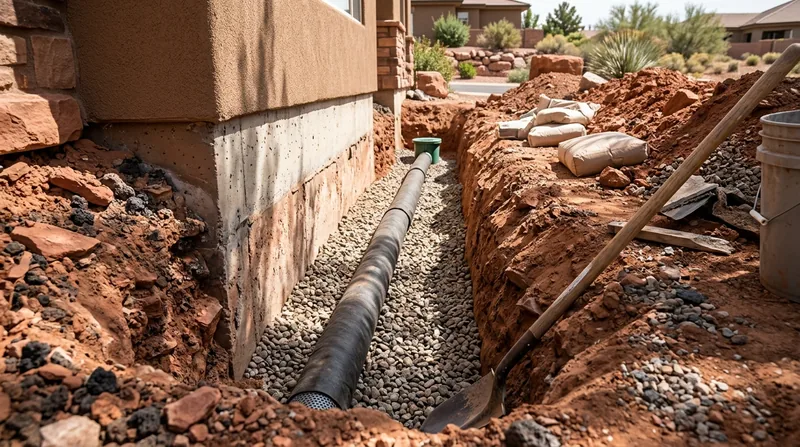




St. George sits where red sandstone cliffs and black lava ridges meet the Virgin and Santa Clara rivers, and that geology drives how water moves around your foundation. Expansive clay and gypsum-rich soils swell when wetted and collapse as they dry, while perched groundwater from landscape and golf-course irrigation keeps the lower soil profile wet long after the last storm. For hillside homes in Stone Cliff, The Ledges, Green Valley, and Entrada, cloudburst runoff arrives from uphill and stacks against the foundation wall. French Drain Installation in St. George intercepts that water before it reaches the lower level, using graded gravel and perforated pipe wrapped in fabric and tied to daylight or a sump basin. We install these systems along the foundation wall, where irrigation runoff and monsoon sheets actually arrive. If you are still deciding between approaches, start with our basement waterproofing overview, then we can size the drain correctly.
Why French Drains Matter on St. George Hillside Lots
Most water problems we see in Washington County do not come from a rising water table under the whole neighborhood. They come from water that lands uphill and travels downslope through sandy fill and clay lenses until it hits a foundation wall or a walk-out lower level. Homes stepping down the hillsides of Stone Cliff and The Ledges collect that flow at the rear wall, and older ranch homes near Dixie with lower levels close to grade collect it at the footing.
- Uphill irrigation from lawns, palms, and mesquite plantings keeps soil saturated long after the sprinklers shut off.
- Monsoon cloudbursts dump intense runoff in minutes, overwhelming surface grading and downspout extensions.
- Expansive clay and gypsum soils swell against the wall, then lose strength and settle after drying cycles.
- Walk-out lower levels on sloped lots put a finished wall directly in the path of downhill flow.
A properly graded gravel and pipe system moves that water away from the wall instead of letting it sit against the footing.
Key info: On a Green Valley lot we inspected, the rear wall stayed damp weeks after the irrigation schedule changed, because water from the uphill neighbor's landscape was traveling through sandy fill and surfacing at the footing. A fabric-wrapped drain along that wall, tied to a sump basin, moved the flow before it reached the wall.
For the official rules on drainage work and permits, check the City of St. George building department before work begins.
How We Install a French Drain on a St. George Foundation
We start by finding where the water actually enters, not where the stain shows. On desert lots that means checking grading, downspout extension points, irrigation heads, and the uphill side of the wall before we dig. Then we lay out the trench line, confirm the outlet, and only then open ground.
- We walk the lot and mark the flow path, including irrigation lines and utility locates, before any digging.
- We excavate a trench along the foundation wall to the footing depth the lot requires.
- We line the trench with filter fabric so clay and gypsum fines cannot clog the gravel.
- We set perforated pipe on graded gravel so the run falls continuously toward the outlet.
- We wrap the gravel in fabric and backfill with clean material, then restore grading away from the wall.
- We tie the outlet to daylight on a downslope, or to a sump basin and pump where gravity is not available.
Every run gets tested with water before we close the trench, so we know the fall and the outlet work together.
Key info: A Santa Clara home on a slope had no gravity outlet at the rear, so we tied the drain to a sump basin with a check valve and discharge line that carries water to the front of the lot. That combination is common on hillside lots where the rear wall is the low point.
Where the water is already inside the basement, an interior drain tile system is often the better answer than exterior excavation, and we will say so plainly.
French Drain Approaches We Use Around St. George
Not every lot needs the same system. The right choice depends on slope, soil, outlet options, and whether the water arrives from uphill or rises at the footing. Here is how the common approaches compare.
| Approach | Description | Best for |
|---|---|---|
| Exterior footing drain | Fabric-wrapped gravel and perforated pipe along the foundation wall, tied to daylight or a sump basin. | Hillside lots with uphill runoff and irrigation flow. |
| Surface swale and grading | Regraded soil and shallow swales that move sheet flow away from the wall before it soaks in. | Lots with minor seepage and good downslope room. |
| Drain to sump basin | Drain run collected in a basin and pumped out through a check valve and discharge line. | Sites with no gravity outlet at the low side. |
| Downspout and irrigation correction | Extensions and rerouted heads that stop concentrated water from landing at the wall. | Homes where the source is roof or landscape water. |
We often combine two of these on the same lot, because desert homes rarely have a single water source.
French Drain Installation Cost in St. George: What to Expect
Most exterior runs start around From $25 per linear foot, and that figure covers excavation, filter fabric, graded gravel, perforated pipe, and backfill. The number moves with trench depth, soil conditions, outlet options, and access. A short run on a flat lot in Washington is a different job from a deep hillside cut in Stone Cliff where the trench has to reach the footing and the outlet needs a sump basin.
- Trench depth and length drive the base number more than any other factor.
- Rock, caliche, and gypsum layers slow excavation and add labor.
- No gravity outlet means a sump basin, pump, check valve, and discharge line.
- Tight side yards and finished landscaping raise the cost of access and restoration.
- Combining the drain with grading and downspout corrections changes the scope.
Get two or three written estimates on the same scope so you compare the same work, not just the same headline number. Our pricing page breaks down how we build a quote.
Hiring a Waterproofing Contractor Near Me in St. George
Ask for the license and insurance certificate before anyone digs, and confirm the policy covers excavation work. Get at least two or three estimates on the same written scope, and ask each contractor to explain the outlet, not just the trench. Call references from jobs at least a year old, because a drain that clogs in the first season was built wrong.
Ask who pulls the permit. Work that alters drainage or the sanitary connection of a sump discharge commonly needs one, and thresholds vary by jurisdiction, so confirm with the City of St. George building department. If your lot sits in an HOA, check the architectural rules for grading and discharge before the crew arrives. We are a Basement Health Association member and can walk you through the scope. Reach us through our contact page to set up a free inspection.
French Drain Installation in St. George: Pricing Guide
| Service | Price | Details |
|---|---|---|
| Exterior french drain along foundation wall | Starting at $25/linear ft | Includes excavation, filter fabric, graded gravel, perforated pipe, and backfill along the wall |
| Drain tied to sump basin with pump | Starting at $1,800 | Adds basin, pump, check valve, and discharge line where no gravity outlet exists |
| Deep hillside trench with rock or caliche | On estimate | Rock and gypsum layers slow excavation, so the site needs a look before pricing |
| Grading and downspout correction add-on | Starting at $600 | Regrades soil and extends downspouts to move surface water away from the wall |
| Travel | Included | In St. George and surrounding Washington County areas, no separate call-out or mileage fee |
| Estimate | Free | Response within 24h at (435) 319-8116, no obligation to book |
Indicative pricing, the exact cost depends on square footage, finish, and site access. Free personalized estimate within 24h at (435) 319-8116.


