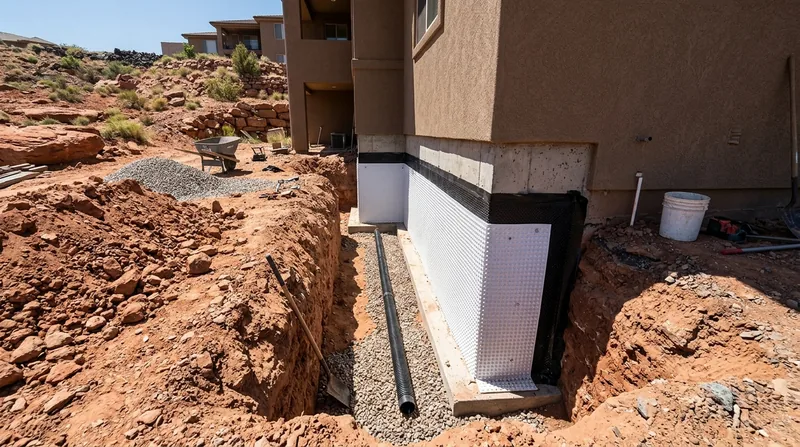




St. George sits where red sandstone cliffs and black lava ridges meet the Virgin and Santa Clara rivers, and that geology drives everything we do below grade. The same expansive clay and gypsum-rich soils that make building lots here tricky also swell, dissolve, and collapse when they get wetted, and perched groundwater fed by landscape and golf-course irrigation keeps pressure against foundation walls year round. If you are searching for Exterior Basement Waterproofing in St. George, you are usually dealing with an uphill wall that stays wet no matter how many times you patch it from the inside. We excavate down to the footing, apply a membrane or dimple board directly to the wall, and correct the grading and downspouts that pushed water into the soil in the first place. This is the most thorough fix for walls that take direct hydrostatic pressure, and it is the one we recommend when interior coatings have already failed. Start with a free basement inspection so we can tell you honestly whether you need excavation or a simpler repair.
Why Exterior Waterproofing Matters on St. George's Slopes and River Bottoms
Washington County homes sit on some of the most reactive soil in Utah. Downtown pioneer homes built of red sandstone and black volcanic rock sit on original stone foundations, while 1950s to 1980s ranches near Dixie and on the Black Hill slopes have lower levels cut straight into clay. Newer stucco homes in Stone Cliff, the Ledges, Green Valley, and Entrada step down hillsides with walk-out lower levels, so one wall is often buried ten feet deep against uphill soil. When monsoon cloudbursts hit, that buried wall takes the full load.
- Hydrostatic pressure builds against uphill walls when clay soil stays saturated after irrigation or a storm.
- Gypsum-rich soils can dissolve and collapse, leaving voids that redirect water straight at the footing.
- Original stone foundations downtown wick moisture and show efflorescence long before water actually puddles.
- Perched groundwater from golf-course and landscape irrigation keeps soil wet even in dry months.
- Washes and river bottoms flash-flood, as they did in 2005, and overwhelm surface grading in minutes.
Every one of those failure modes starts on the outside of the wall, which is why exterior work solves problems that interior patching only manages.
Key info: A home on the Black Hill slopes above St. George can have a wall buried eight to ten feet against expansive clay, while a slab home in Washington has almost no below-grade wall at all. The depth of burial and the soil type decide whether exterior excavation is the right call, and we verify both before quoting.
The Utah Division of Occupational and Professional Licensing maintains the contractor licensing lookup homeowners can use to verify any waterproofing or foundation contractor before work begins: Utah DOPL contractor verification.
How We Take an Exterior Wall Down to the Footing in St. George
Exterior waterproofing is excavation work, and the sequence matters more than the materials. We locate utilities first, then dig a trench along the wall down to the footing, clean the wall surface, and repair any cracks before we cover anything. Only then does the membrane go on. Skipping the crack repair step is the most common reason exterior jobs fail, and it is why we pressure-test our work before backfilling.
- We mark utilities and confirm the excavation line with a locate service before any digging starts.
- We excavate down to the footing and expose the full height of the wall, shoring as needed on deep slopes.
- We clean the wall and repair cracks and honeycombing with epoxy injection or hydraulic cement as the condition requires.
- We apply a waterproof membrane, then dimple board to protect it and create a drainage plane against the wall.
- We install or restore footing drain tile at the base to carry water away from the wall.
- We regrade the soil to slope away from the foundation and extend downspouts well past the backfill.
Once the trench is backfilled and compacted, the wall is protected on the wet side, which is where the water actually comes from.
Key info: On a walk-out lower level in Stone Cliff, the uphill wall is the one that leaks. We excavated a wall buried nine feet against clay, found the original dampproofing had failed at the footing joint, repaired the joint, and installed dimple board and new drain tile. The homeowner had spent two seasons patching interior cracks that were never the real problem.
If the excavation scope is limited to redirecting surface water, a French drain installation may solve the problem at lower cost, and we will say so when that is the honest answer.
Exterior Waterproofing Approaches We Use in Washington County
Not every wet wall calls for the same method. The table below shows the approaches we use across St. George and the surrounding communities, and what each one is actually good for. We match the method to the soil, the burial depth, and the access around the foundation.
| Approach | Description | Best for |
|---|---|---|
| Sheet membrane plus dimple board | Waterproof membrane applied to the wall, protected by dimple board and backed by drain tile. | Deeply buried uphill walls taking hydrostatic pressure. |
| Fluid-applied waterproof coating | Sprayed or rolled coating that seals the wall surface and bridges small cracks. | Shallower walls with minor seepage and good access. |
| Crack repair plus exterior sealing | Structural cracks injected and sealed before the exterior membrane goes on. | Walls with isolated cracks and no broad saturation. |
| Grading and downspout correction | Soil regraded away from the wall and downspouts extended past the backfill. | Homes where surface water, not groundwater, drives the leak. |
| Footing drain tile restoration | Failed or clogged weeping tile replaced at the footing during excavation. | Older homes where the original drain tile has collapsed. |
We recommend the least invasive method that actually solves the problem, and we tell you when a simpler repair is enough.
Exterior Basement Waterproofing Cost in St. George: What to Expect
Exterior waterproofing pricing starts at From $95/linear ft, and that figure reflects the excavation, wall preparation, membrane, and drain tile along a measured run of wall. The final number depends on how deep the wall is buried, how much access the excavation equipment has, and whether we find failed drain tile or structural cracks once the soil is off the wall. A walk-out wall in Green Valley with easy side access prices differently from a downtown pioneer home hemmed in by mature palms and mesquite.
We quote by the linear foot of wall treated, not by the hour, so you know the scope before we start digging. Getting two or three estimates is smart, and we encourage it, because it forces every contractor to put the scope in writing. Ask each one whether crack repair and drain tile are included, since bids that leave them out look cheaper until the wall leaks again.
The full breakdown of what moves the number is on our pricing page, and we walk through it line by line during the estimate.
Choosing a Waterproofing Contractor Near St. George: What Homeowners Should Check
Exterior excavation is not a job to hand to whoever answers the phone first. A contractor who digs without locating utilities, or who backfills before the membrane is inspected, can leave you with a worse problem than the one you started with. Here is what to verify before you sign anything.
- Confirm the contractor is licensed and insured, and ask for a certificate of insurance before work begins.
- Get at least two or three written estimates that spell out excavation depth, membrane type, and drain tile.
- Ask for references from jobs in St. George, Washington, or Santa Clara and actually call them.
- Check whether your project needs a permit from the local building department, since rules vary by jurisdiction and structural or drainage work often requires one.
- Ask how the contractor handles utility locates and shoring on deep excavations.
A straight answer on all five points tells you more than any brochure, and you can contact us to start that conversation.
Exterior Basement Waterproofing Near Me: Matching the Fix to Your St. George Home
Homeowners searching for exterior basement waterproofing near me usually have one wall that stays wet and a stack of failed interior patches to show for it. The honest question is whether the water is coming through the wall from saturated soil or running along the surface from grading and downspouts. We answer that with a site visit, not a sales pitch, and we tell you when an interior drain system is the better answer than excavation.
Older stone foundations downtown often need a different approach than a 1990s stucco home in Ivins, and we adjust the method to the building stock. What we will not do is sell you an excavation you do not need. Call (435) 319-8116 to schedule an inspection and get a straight assessment of your wall.
Exterior Basement Waterproofing in St. George: Pricing Guide
| Service | Price | Details |
|---|---|---|
| Exterior wall membrane and dimple board | From $95/linear ft | Includes excavation, wall prep, membrane, dimple board, and drain tile along the run. |
| Crack repair plus exterior sealing | From $115/linear ft | Adds epoxy or polyurethane injection and sealing before the membrane goes on. |
| Grading and downspout correction only | From $1,200 | Regrades soil away from the wall and extends downspouts past the backfill. |
| Complex or large-scale excavation | On estimate | Deep burial, tight access, or failed footing drain tile needs an on-site look first. |
| Travel | Included | in St. George and surrounding Washington County areas, no separate call-out or mileage fee. |
| Estimate | Free | Response within 24h at (435) 319-8116, no obligation to book. |
Indicative pricing, the exact cost depends on square footage, finish, and site access. Free personalized estimate within 24h at (435) 319-8116.


